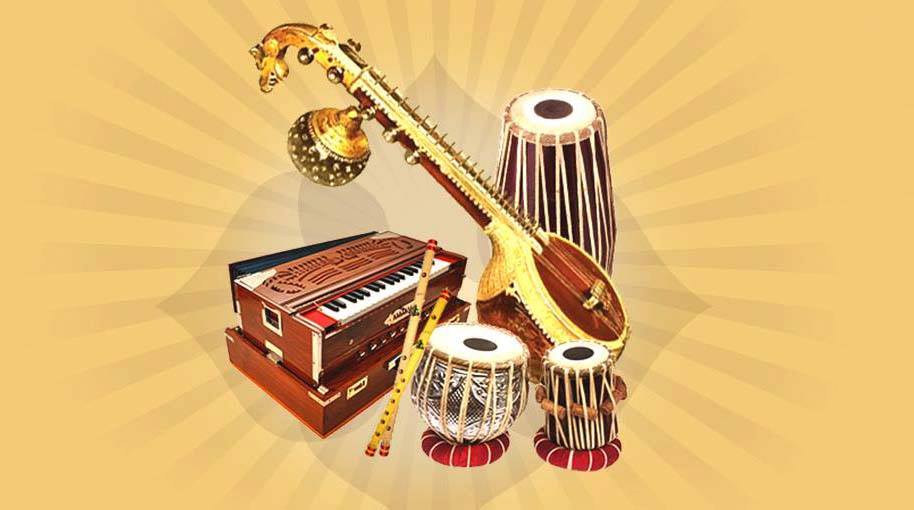
One of my main reasons in creating this website was to put together a comprehensive and easily accessible resource for North Indian (Hindustani) classical music theory, simply explaining and demonstrating all the basic concepts from scratch so that anyone, whether with a background in music or not, can understand.
Please note that I am not sponsored by or endorsing any of the products or services listed on this page. I simply offer them as examples of what is available out there.
Online Hindustani Music Database
The SwarGanga Music Foundation offers well-organized databases of ragas, taals, bandish and so on. The raga database provides information on close to 500 Hindustani classical ragas, the bandish database offers nearly 3000 bandish, and the taal database includes a list of 64 taals. Audio demonstrations are available for most of the ragas, and also for many of the bandish and taals.
Indian Classical Music Education
.jpg?timestamp=1593429943221)
Typically, those who learn Indian classical music begin their training as children under private tutors. Most Indian towns and cities have private tutors who offer individual or group lessons in vocal or instrumental music, and children usually attend these lessons after school.
Useful list of private tutors in various cities not just in India but around the world. In the larger cities, there are also formal institutions that offer music courses that one can attend.
Regardless of how you acquire your training, you can register for and take accredited examinations at different points in your musical training. ClassicalVocalMusic These exams are given by the Akhil Bharatiya Gandharva Mahavidyalaya Mandal, and students earn certificates for each relevant level upon passing.
There are many levels, starting at prarambhik (elementary) and going right up to visharad (equivalent to a bachelor's degree), alankar (a master's degree), or sangitacharya (a doctor's degree).
Several universities and institutes across India offer degrees in Hindustani classical music.
The traditional Indian gurukul system of learning under a guru by becoming a part of the guru's household still exists to a large extent in the field of music. You can affiliate yourself with a guru, learn under them for an extended period of time, and carry on their tradition in the true sense.
Voice Training Tips
The style of voice production is different in different genres of music. Think of how different an opera sounds compared to jazz music. Or how different Hindustani (North Indian) classical music sounds compared to Carnatic (South Indian) classical music.
As you go through the process of initial vocal training, you will find out where your chest voice range begins and ends. You can then chose a tonic (sa) that locates your main octave comfortably in the middle of that range (just for reference: women tend to choose some pitch between G and B as their sa, while men generally settle on some pitch between C and E♭).
Learning to Sing at Higher Pitches
Different pitches resonate best in different cavities within the body. Specifically, going from the lowest to the highest pitches, the main resonating areas are the chest cavity, the tracheal tree, the larynx, the pharynx, the oral cavity, the nasal cavity, and the sinuses. https://en.wikipedia.org/wiki/Hindustani_classical_music The key is to learn how to project your voice appropriately to achieve the maximum resonation possible for all the pitches you are required to produce.
Well, theory is all very well and it is good to be aware of it, but the best way to learn how to mix chest and head tones effectively is by imitation. Most good vocalists have had the good fortune of learning with a teacher whose style they were able to observe and imitate over the years.
Singing in Akar
The challenge is to train your voice to sing each note with precision and clarity without the consonants. Serious students must eventually practice singing in all of the pure vowel sounds - ā, i, u, e and o, as well as the nasal consonants n and m, because the voice behaves differently with different vowels. Some notes are harder to hit with certain vowels.